
They Gave Everything.
Don't Let Their Story Die With You.
You're the last generation who knew them. Their service record holds the truth they never spoke. We turn it into a story your grandchildren can read, understand, and carry forward.
1.1 Million Australians Served.
Their Stories Will Be Lost Forever.
"Dad never talked about it. Mum took what she knew to her grave. Now I'm holding pages in a language no one alive understands."- The experience of tens of thousands of Australian families, right now
From the Boer War to Vietnam. Every one of them left behind a record. Most have never been decoded.
Written in copperplate handwriting and army speak shorthand that takes specialists decades to learn to read.
The adult children who carry living memory of their parents' service are ageing. When they go, the last context goes with them.
Pages Preserved. Stories Forgotten.
Thanks to a remarkable effort by the National Archives of Australia and volunteers, the physical records are preserved. Every page. Every entry. Digitised and waiting but a scan of copperplate handwriting and army speak shorthand from 1916 is not a story. It's not a legacy. It's not something you can hand to your grandchild and say: "This is who they were. This is what they went through."
Dedicated volunteers at the Australian War Memorial spend hours with visiting families, carefully decoding records line by line. Their work is extraordinary but there are fewer of them every year, and for most Australian families, the trip to Canberra is simply not possible.
The true intent of preservation was never just to archive pixels. It was to make history understandable. A shared culture, common remembrance, a living connection across generations. That last step, from scanned record to living story, has never existed... Until now.
"Every year we wait, another family member who could have told us the context dies. The window to do this properly is closing."
The Urgency Is Real. The Time Is Now.Decode Their Story - $59From a Record No One Can Read.
To a Story No One Will Forget.
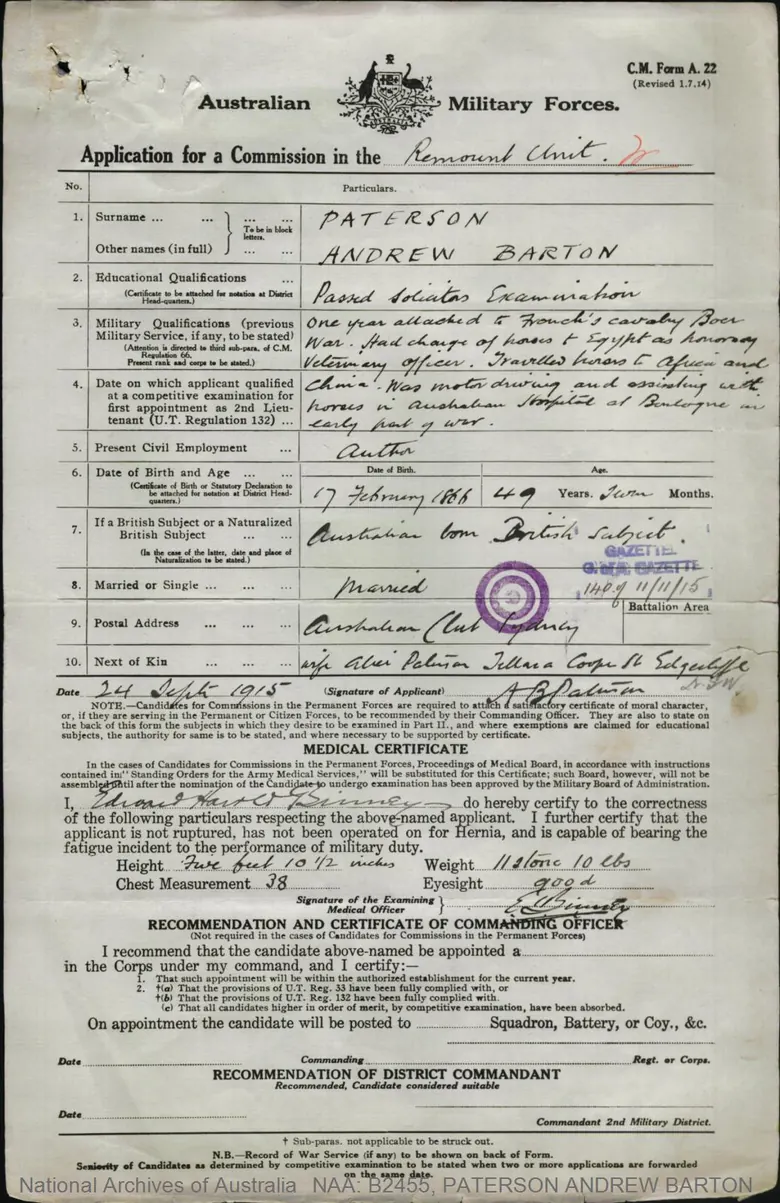
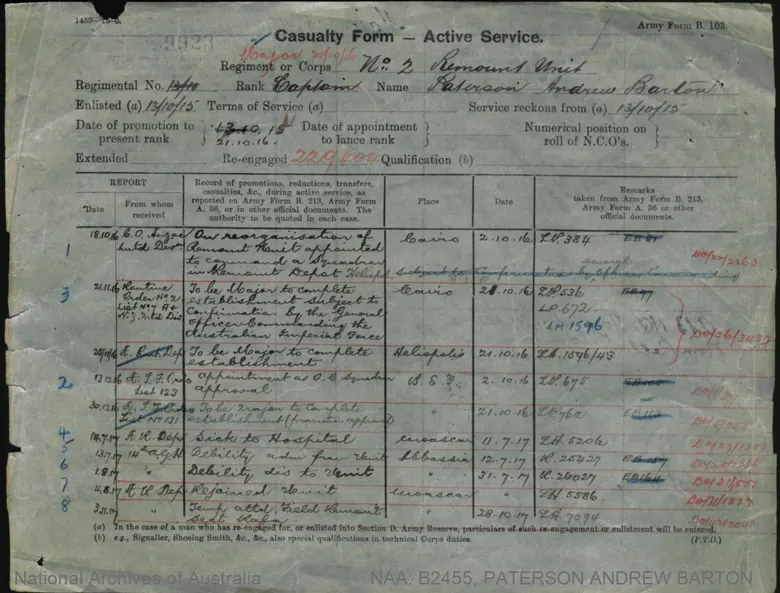
Click through Banjo Paterson's real WWI record, its translation, and the full story.
National Archives of Australia · NAA: B2455 · PATERSON, ANDREW BARTON
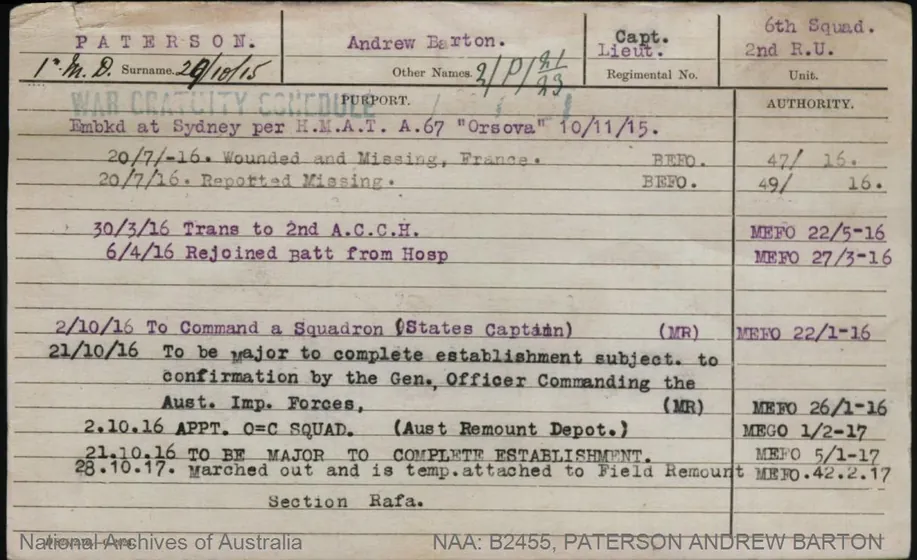
Downloaded from NAA RecordSearch (NAA: B2455, Item ID: 4028776). No pre-processing, no enhancement.
Crown copyright expired 1 January 2024 under the Copyright Act 1968 (Cth).
The Moment You Finally Understand
Imagine sitting down with a document that tells you everything your father never said. Where he went. What he endured. The wounds he carried home. Not in abbreviations and military codes, in words finally make sesnse of a story you were never told.
The Story You Hand Down
Imagine your grandchildren reading about their great-grandmother's service the way they'd read an Australian Story, understanding what she gave, feeling proud of where they come from. You make sure her story is told properly. They carry it forward long after you're gone.
The ANZAC Day That Becomes Personal
Imagine standing at the cenotaph next April knowing exactly what your family's Digger went through. Not the general history, their specific postings, their wounds, their mates. Remembrance stops being abstract. It becomes your family's story, carried forward by every generation that follows.
Every family's story starts with one record. Yours is waiting.
Decode Their Story - $59Three Steps to Their Story.
1. Upload Their Record
Download your relative's service record from the National Archives website (free and publicly available). Upload the scanned images - we'll guide you if you're not sure where to start.
2. We Decode and Write
Every abbreviation translated, every date expanded, every posting cross-referenced against official war histories. We turn the raw record into a complete narrative of their service.
3. Receive Their Story
Within days, receive a professionally written service narrative your whole family can read - plus a full timeline of every entry decoded. Ready to share, print, or keep forever.
Where to Start
| Criteria | Do it yourself | Professional genealogist | Decode My Digger |
|---|---|---|---|
| Cost | Free (plus your time) | $500 - $1,500+ | $59 per record |
| Turnaround | Weeks to months | 4 - 8 weeks (limited availability) | Days |
| What you receive | Your own notes | Research report (varies by scope) | Complete narrative + decoded timeline |
| Copperplate and abbreviations | If you can decipher them | Yes | Every entry, every abbreviation |
| Historical context | Requires separate research | Depends on engagement | Mapped to campaigns, battles, and official histories |
| Travel required | Possibly (AWM, state archives) | No | No - upload from home |
| Availability | Anytime (if you have the skills) | Fewer specialists every year | Available now, any record from the Boer War to Vietnam |
Need deeper research beyond the service record? A professional genealogist or historian can help with family history, unit war diaries, and broader archival research. Your decoded record gives them a head start.
Your Family's Story, Done Properly.
Every Fact Verified. Every Word Earned.
Your family's story deserves to be told accurately. Every entry is cross-referenced against official National Archives records and war histories, held to the rigour of academic research, written in language your whole family can understand.
Aligned With the Institutions You Trust
Built with deep respect for the National Archives, Australian War Memorial, and RSL. The organisations that preserved these records set the benchmark. We hold ourselves to their standard.
Every Entry. As Recorded.
"Archaeology is the search for fact, not truth." - Indiana Jones
Service records documented everything. We decode every entry literally - including disciplinary actions, medical conditions, and criminal proceedings. Nothing omitted. Nothing softened.
Your records are processed securely and never shared.
Frequently asked questions
What types of Australian military records can you process?
We process digitised service records from the National Archives of Australia across all conflicts involving Australian forces, including:
Boer War (1899-1902), Boxer Rebellion (1900-1901), World War I (1914-1918), World War II (1939-1945), Korean War (1950-1953), Malayan Emergency (1948-1960), Indonesian Confrontation (1963-1966), and the Vietnam War (1962-1975).
This includes Army, Navy, and RAAF personnel dossiers across all major series. If you have records from the NAA RecordSearch database, we can most likely decode them. If you are unsure whether your record is supported, upload it and we will let you know.
How long does it take?
Most records are fully processed within 12 to 15 minutes of upload. This is not instant because your record is not being run through a simple scanner. It passes through five layers of processing - handwriting extraction, military terminology deciphering, historical research, narrative composition, and structured spreadsheet generation. Complex records with a high number of pages may take slightly longer. Once processing is finished, your completed Word and Excel reports become available for download from your account.
How is this different from Ancestry?
Ancestry and similar platforms give you access to the raw records and leave you to interpret them yourself. Decode My Digger does the interpretation for you - but it goes further than translation. Your relative's record is processed through five layers of extraction, deciphering, historical research, and contextualisation to produce two outputs: a personalised narrative that reads like a book, and a line-by-line spreadsheet with every entry translated into modern terminology. It is a one-off purchase, not a subscription.
What if the records contain something unexpected?
Service records are official military documents. They record everything - including things families may not expect. It was standard practice for the Australian military to document disciplinary actions, criminal proceedings, periods absent without leave, and medical conditions including sexually transmitted infections (historically recorded as venereal disease). These entries appear in many records and do not diminish your relative's service. They reflect the reality of wartime.
Your decoded report presents these entries factually and in plain language, exactly as they appear in the original record. It is delivered as an editable Word document and Excel spreadsheet so your family has full control over what you keep, what you add to, and what you choose to share.
Is my relative's information kept private?
The original service records are publicly available through the National Archives of Australia - anyone can search for and download them. What we produce from those records is different. Your decoded report, personalised narrative, and structured spreadsheet are generated specifically for you. We do not publish, share, or reuse your decoded outputs for marketing, training, or any other purpose. Uploaded images are permanently deleted from our systems 90 days after processing. See our Privacy Policy for full details.
What if the records are hard to read?
Australian military service records are handwritten documents that are often over 100 years old. Faded ink, damaged pages, and inconsistent handwriting are normal - and our system is built to handle them. Where a specific entry cannot be extracted with confidence, it is noted as illegible in your report rather than guessed. A record is considered successfully decoded when 80% or more of the content has been meaningfully extracted and interpreted. In the rare case that a record falls below this threshold due to severe document damage, we will issue a full refund.
Where do I get the records to upload?
Service records are held by the National Archives of Australia. You can search for and download digitised records through their RecordSearch database. We also have a step-by-step guide to help you find them.
What families are saying
"My grandfather enlisted three days after Darwin was bombed. I had his records for years but could never make sense of them. This put everything into context - his postings, his unit transfers, even a stint in hospital I never knew about. It reads like a mini-series. I could never have pieced that together on my own."
"I wasn't expecting much, honestly. I thought I'd get a summary and a few translations. Instead I got a full narrative report and a line-by-line spreadsheet that decoded every single entry. Worth every cent."
"It answered questions I didn't even know to ask. I knew Dad served in New Guinea but I had no idea what half the entries in his file meant. Now the whole family understands what he went through."